CASE STUDY | E-COMMERCE | TECHNICAL SEO | DOMAIN RECOVERY
Recovering organic traffic after a domain compromise
How I tripled organic sessions in 3 months for a phone parts e-commerce dealing with reputation damage and a hacked domain, where two previous SEOs had failed.
2
Previous SEOs who couldn’t move the needle
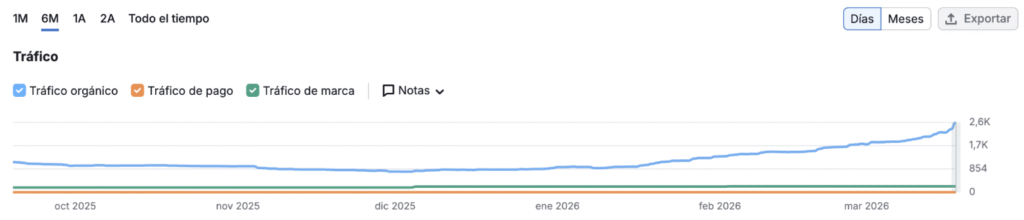
3X
Organic traffic in 3 months
Ongoing
Active engagement, continued growth
CONTEXT
A site the previous SEOs couldn't fix
This Spanish e-commerce sells replacement parts and accessories for phones, tablets, and smartwatches, exclusively online, no physical retail presence. When I took over the account, the site had been struggling with two compounding problems for an extended period.
Two SEO specialists had worked on it before me without producing measurable results. I was brought in with a clear mandate: diagnose what was blocking growth and fix it.
Problem 1
Domain compromise from a previous hack had damaged the site’s technical health and search reputation, residual issues that previous work hadn’t fully addressed.
Problem 2
Business-related reputation issues further suppressed organic visibility, compounding the domain signal problems with negative off-page factors.
DIAGNOSIS
What was actually blocking growth
The first priority was understanding why two experienced SEOs had failed to move the numbers. In cases like this, the instinct is often to focus on content and on-page optimization, but when a domain has been compromised, those efforts don’t compound correctly until the technical and trust signals are clean.
Post-hack domains require a different prioritization order. Standard on-page SEO work assumes a clean technical foundation. Here, the foundation had structural damage that needed to be resolved before anything else could gain traction. That’s where I started.
The audit revealed unresolved technical debt from the hack: residual spammy signals, crawl issues introduced by the attackers, and a trust deficit in Google’s assessment of the domain that content improvements alone couldn’t offset.
STRATEGY
The recovery steps
Crawled the site to identify what the hack had left behind: injected URLs, abnormal redirect patterns, compromised pages still indexed. Built a remediation list before touching any content.
Cleaned remaining hack-related artifacts. Fixed crawl errors, 404s, and redirect chains. Resubmitted clean sitemaps. Addressed any signals that could be causing Google to distrust the domain.
With the technical foundation stabilized, moved to product and category page optimization, keyword targeting, meta tags, heading structure, internal linking and targeting the content to the right audience. Work that would now have room to compound.
With core recovery achieved, shifted to proactive growth strategy. Still active on this account, expanding organic reach into new product categories and search intents.
RESULTS
Triple the traffic
3x
Organic sessions tripled within three months of taking over, a result that had eluded the two previous SEO specialists despite extended engagement on the same site.
TIMELINE
90 days
From start to 3x organic traffic
STATUS
Active
Ongoing work continuing to build on initial recovery
Traffic data sourced from Google Search Console. Client and domain identity anonymized per NDA.
TAKEWAYS
What this demostrates
Diagnostic accuracy before execution. The previous SEOs likely applied standard SEO playbooks to a non-standard problem. Identifying that the domain’s trust signals were the root cause, not content quality, was what unlocked progress.
Technical SEO in adversarial conditions. Post-hack recovery requires familiarity with how attackers manipulate site structure, what Google flags as trust violations, and how to systematically clean those signals. It’s a different skill set from standard technical SEO.
Sequencing matters. The work wasn’t harder than what the previous specialists had don, it was done in the right order. Technical foundation → trust signals → on-page → growth. Reversing that sequence explains why content work alone produced no results.
Contact Me
Available from May 13 | Ontario | Open to agency, in-house, and remote roles